The Permitting Deal Congress May Not Get Again
The House should approve the Bipartisan American Affordability and Jobs Act before this Congress ends. The next Congress offers no credible route to a better deal.
On November 19, the Senate voted 62-33 to pass the Bipartisan American Affordability and Jobs Act of 2026 (BAAJA). After years of failed negotiations, a bipartisan permitting agreement is now before the House. Representatives should approve it promptly and send it to the President before this Congress ends.
The remaining weeks should be used to secure passage in both chambers. Reopening the central compromises would put the agreement at risk just as it approaches the finish line. Meanwhile, projects awaiting permits and the resolution of legal challenges continue to incur costs. Some will lose their financing or cease to be commercially viable before Congress gets another chance.
Democrats will control both chambers in January, but Trump will remain president. A more Democratic bill will lose the concessions that secured his support, while the incoming committee leadership will demand terms Republicans reject. The prospects for another comprehensive agreement before 2029 are poor enough that Congress should proceed on the assumption that this is its last opportunity.
The Cost of Waiting
Infrastructure projects can die long before anyone announces their cancellation.
Developers may spend years acquiring land, commissioning engineering studies, obtaining permits, negotiating financing commitments, and securing prospective customers before construction begins. During that period, they must continue paying attorneys, consultants, and engineers while maintaining contractual rights and other arrangements necessary to keep the project alive.
Those costs can become substantial. Land options expire and must be renewed. Equipment suppliers revise their quotations. Contractors become unavailable. Prospective customers seek alternatives. Meanwhile, interest rates, construction costs, and expected revenues can change enough to undermine the project’s original business case.
For large infrastructure projects, permitting uncertainty also affects access to capital. Lenders and investors need a reasonable degree of confidence that a project can obtain its necessary approvals, begin construction, and ultimately generate revenue. An uncertain permitting schedule makes it harder to determine how much capital the project will require, when that capital must be committed, and when investors can expect to receive a return.
The consequences can include larger contingency requirements, more expensive financing, and a smaller pool of willing investors. In some circumstances, a developer may be unable to arrange financing at all until the outstanding regulatory risks have been resolved.
Those costs do not stay with the developer. For capital-intensive projects, the cost of capital is a large share of what customers ultimately pay. A regulated utility recovers its financing costs through rates. A merchant generator needs higher contract prices to clear a higher hurdle rate. A permitting risk premium therefore shows up on every electricity bill and in the price of everything that depends on power. That makes permitting reform an affordability measure: lowering the risk that government delay will strand a project lowers the return investors must demand to finance it.
The scale of the problem is considerable. McKinsey estimated in October 2026 that roughly $1.8 trillion in infrastructure capital expenditure is currently moving through federal permitting, about $1.1 trillion of it privately financed. Its 2025 study, using a capital-expenditure-weighted methodology, estimated average federal permitting durations of four to five years across eight major infrastructure sectors.
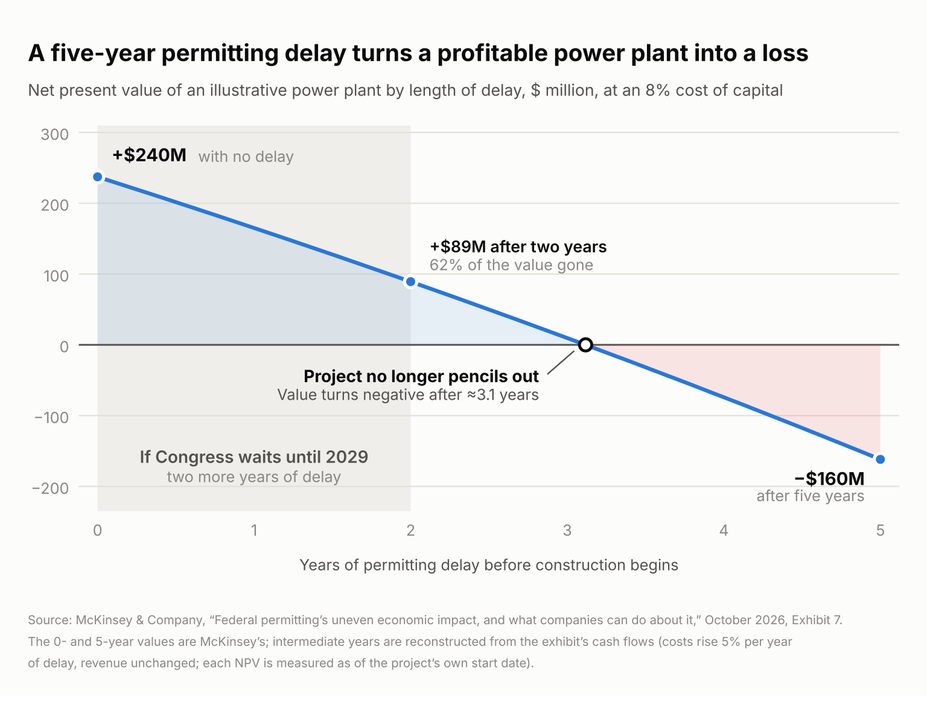
The October 2026 analysis also estimated that permitting delays were associated with roughly a 5% annual increase in total project costs across the capital-intensive sectors examined. In one illustrative power-generation project, a five-year delay in beginning construction transformed a project with approximately $240 million in positive net present value into one with an estimated $160 million loss.
These are modeled estimates, and the delays involved arise from multiple sources. But the basic economic mechanism is familiar to anyone involved in project development or financing. A project that makes financial sense today may no longer make sense after several additional years of carrying costs and uncertainty.
The broader consequences are also difficult to capture in conventional economic statistics. A delayed transmission line can prevent generating capacity from reaching customers. An abandoned factory never purchases equipment or hires its expected workforce. A housing development that never receives approval adds nothing to the available supply of homes.
For projects that would otherwise be viable, years of permitting and litigation delays can be enough to prevent construction. Congress should weigh those losses when deciding whether to keep negotiating.
What BAAJA Would Change
The Senate-passed bill addresses federal environmental review, permitting, project certainty, and electricity transmission. Its changes to the National Environmental Policy Act (NEPA), the Clean Water Act, the Endangered Species Act, and other statutes would make a practical difference to developers trying to reach a financeable construction date.
Section 1106 would strengthen lead-agency responsibility for coordinating federal reviews and scheduling associated authorizations. Section 1107 would extend the period for relying on programmatic environmental reviews from five years to ten, subject to the statute’s conditions. Developers should not have to pay for the same analytical work every time an agency considers a related project.
Section 1110 would generally require covered NEPA challenges to be filed within 150 days and direct courts to remand NEPA defects for correction without vacating the challenged decision. It would also restrict injunctions, reserving them for specified circumstances involving violations of other federal law. These are meaningful changes to litigation remedies, intended to let projects proceed while procedural defects are corrected.
For investors, the question of when a permit becomes sufficiently final is particularly important. A developer that has completed years of environmental review, obtained its permits, and arranged construction financing may still face significant losses if those approvals are subsequently withdrawn or suspended.
Section 1401 would protect fully federally permitted projects with nonfederal sponsors across industries. Agencies would have to justify interference under a statutory exception and carry that burden in court. Available relief includes reinstatement of approvals and recovery of appropriate delay costs; the additional award of 25–50% of incurred development and construction costs requires bad faith. The Senate’s revisions preserve lawful agency action, court orders, enforcement against fraud and violations, and responses to specified new threats.
Section 1402 addresses intentional patterns of discriminatory permitting delays or denials across specified energy categories, including nuclear, wind, solar, oil, gas, coal, pipelines, and transmission. It uses a ten-year comparison period and requires evidence of a qualifying pattern. A hostile statement alone would not establish a claim.
Trump supplied a useful example on November 9. Moments after endorsing the permitting bill, he said: “No, I will not approve wind turbines.” That is precisely the kind of technology-based hostility that makes enforceable permitting rights valuable. Wind developers need protection against arbitrary interference by a Republican president. A pipeline developer needs the same protection when a Democrat occupies the White House.
Trump’s own Interior Secretary has acknowledged this point. Asked about the President’s remarks, Doug Burgum said that projects would be “treated equally under the new law” and that those concerned “should just read the bill because that’s what will become law.”
The project-certainty provisions establish that common rule for qualifying projects of every kind. They give developers a way to defend their approvals and recover losses from unlawful interference, regardless of which party controls the agencies. Lenders should be able to assess a project against legal requirements that survive an election.
Section 2101 would extend the backstop transmission-siting authority of the Federal Energy Regulatory Commission (FERC) beyond designated national-interest corridors, while retaining the exception for the ERCOT region of Texas. The bill preserves the state-first conditions for a federal construction permit, including the existing routes following state denial or a year without a decision. It allows federal pre-filing to overlap with state proceedings; it does not create an unrestricted right to pursue both full permit applications simultaneously.
This matters because new generation is of limited value if developers cannot connect it to the grid or deliver its output to customers. Transmission congestion and inadequate interconnection capacity can constrain electricity supply even when investment in new power plants is available.
Section 2110 addresses generator-interconnection studies. Section 2107 would protect other retail customers from incremental costs attributable to data centers and other large computational loads and require financial assurances for related infrastructure. These provisions matter as utilities consider how to connect new generation and serve large customers without leaving households responsible for their costs.
For nuclear power, Section 1501 would permit the Nuclear Regulatory Commission (NRC) to dispense with specified uncontested licensing hearings when no affected person requests one, subject to notice requirements. Section 1503 exempts specified nuclear authorizations from the new post-review permit-decision deadlines and from Section 1403(b)’s one-year deadline for permits requiring neither an environmental assessment nor an environmental impact statement. It does not remove NEPA’s basic one-year and two-year deadlines for preparing those environmental documents.
BAAJA would therefore leave the need for a comprehensive NRC licensing deadline unresolved. Nuclear developers would still gain useful procedural and project-certainty protections. Congress can enact those gains now and pursue additional nuclear reforms afterward.
Answering Critics on the Right and Left
NRDC opposes the revised bill because it narrows environmental review and judicial remedies, despite supporting its transmission provisions. But the remedies BAAJA narrows are remedies for paperwork, not harm. A project that violates other federal law can still be enjoined, and agencies can still enforce against violations. What ends is the ability to stop a lawful project indefinitely over a correctable defect in its environmental documents. A review process needs a workable endpoint if a lawful project is ever to secure financing and begin construction.
The permit-certainty provisions also preserve agency authority to enforce applicable law and respond to specified hazards. The additional bad-faith award would require proof of misconduct; it would not compensate every disappointed applicant or insulate a developer from the consequences of violating its permit. Protecting investment against arbitrary government action is compatible with holding developers to legal requirements.
The Clean Air Task Force argues that the new remedies may still leave an administration room to obstruct wind projects, and that narrower NEPA remedies would remove one existing avenue of challenge. For projects with all required federal approvals, Section 1401 would put the burden on the government to justify interference and let courts reinstate permits, award delay costs, and supervise further agency action. That would strengthen a developer’s position when challenging a politically motivated stoppage. Congress should enact those protections.
Critics on the right have a different concern. As the American Consumer Institute has argued, broader federal transmission authority could expose customers to the costs of another state’s renewable-energy mandates. Conservatives are right to insist that a state should bear the costs of its own policy choices. They are also right to scrutinize utilities’ incentives to build expensive assets on which they earn regulated returns.
BAAJA addresses that concern through cost-allocation requirements in Sections 2101 and 2103. Costs must be roughly commensurate with benefits, and customers receiving no benefit, or benefits trivial relative to their allocated costs, cannot be charged involuntarily. Reliability, congestion relief, reduced losses, and access to cheaper delivered power are relevant benefits. A neighboring state’s preference for a particular generation technology does not, by itself, establish that its neighbors should pay.
The bill also targets waste in the existing system. Travis Fisher and Michael Abi-Nader have emphasized the weak scrutiny that many local transmission projects receive. Section 2104 would allow state commissions to refer problematic utility planning to FERC for investigation. Section 2105 would restrict federal rights of first refusal for certain regional projects. Better oversight and competition offer consumers a way to challenge spending that incumbent utilities might otherwise pass through to their bills.
The expansion of federal siting authority is real. It is justified by the interstate nature of the grid and paired with consumer protections and a continuing state role. A state line should not become an indefinite barrier to a useful interstate connection. Nuclear and gas plants need transmission too; refusing to build it because wind and solar would also benefit makes reliable generation harder to develop.
Forecast benefits can be overstated, and FERC will need to enforce the cost-allocation requirements. The existing system already allows questionable utility spending while making useful interstate lines difficult to build. Rejecting BAAJA would preserve both problems.
Fiscal critics should also read the Congressional Budget Office’s November 13 estimate closely. It projects a deficit increase below $1 billion over 2027–2036, with faster permitting bringing some previously authorized infrastructure spending into that period. CBO also expects additional private investment, stronger growth, and job creation, whose budgetary effects are not fully captured in its preliminary conventional estimate.
Neither side gets its preferred energy policy from this bill. Both obtain a more workable process for projects they want built. Congress should enact that agreement while the votes and presidential support are available.
Why Waiting Until the Next Congress Will Fail
The agreement rests on a specific political alignment. Republicans Shelley Moore Capito and Mike Lee and Democrats Sheldon Whitehouse and Martin Heinrich negotiated the package and jointly urged its passage on November 7. The administration formally endorsed it on November 9. Those are commitments to the present compromise.
The 62 senators who voted for the final passage have put an agreement within reach. House Natural Resources Chairman Bruce Westerman has urged swift passage. Leaders of the New Democrat Coalition, a group of more than 110 House members, have tentatively endorsed the bill. Speaker Mike Johnson has said he will try to pass it under suspension of the rules after the House returns on November 30. That route requires a two-thirds vote, roughly 71 Democrats even if every Republican votes yes. Whether this agreement becomes law is now largely up to House Democrats.
The tribal concerns some Democrats have raised do not require reopening the bill. Its Senate authors prepared a bipartisan amendment that would require tribal consultation for all federally funded projects that may affect tribal resources and raise the annual authorization for state and tribal historic preservation offices by $100 million. Senators Merkley and Wyden blocked a vote on it on November 19. Senator Capito has suggested the House pass BAAJA as-is and attach the fix to the government funding bill due by December 11. By contrast, any House amendment to BAAJA itself would send the bill back to a Senate with few days left in the session.
Democratic control of Congress next year will change who writes the legislation. It will leave Trump’s signature and sufficient Republican Senate votes essential to enactment. A stronger negotiating position within Congress cannot resolve that conflict.
Alex Epstein’s argument is persuasive: Trump will not sign “a better Democrat bill that punishes oil and gas.” The incoming Democratic committee chairs will not write a package Republicans can accept while pursuing their own priorities for additional restrictions on development and fossil fuels. Epstein points specifically to the expected influence of Jared Huffman, Frank Pallone, and Jeff Merkley. The two sides’ demands will leave little room for the agreement BAAJA requires.
Representative Scott Peters reaches the same conclusion. In his November 19 statement, the California Democrat urged House passage before this Congress ends. Trump’s continued presidency and the Senate’s 60-vote threshold, he argued, would require another bipartisan agreement next year, emphasizing “there will be no better deal on the table.”
Merkley has already made the conflict explicit. In his November 9 statement, he praised the transmission and data-center provisions, opposed the bill’s facilitation of fossil-fuel development, and urged consideration in the new Congress. The concessions he objects to are central to obtaining Republican support. Removing them would satisfy some Democratic critics while losing the votes and presidential agreement needed to enact the result.
Republicans would have their own reasons to wait. They could seek better terms or refuse to hand the incoming Democratic majority a major legislative achievement. Each party could believe that holding out improves its position. Developers would bear the cost of the resulting stalemate.
That points to two years of deadlock, followed by another attempt under a new Congress and president in 2029. Even then, an agreement would have to be negotiated again. Congress should treat 2029 as the earliest credible reopening of this opportunity, not as a date on which reform is assured.
The Cost of Waiting Until 2029
Two more years of deadlock would do more than extend the delays described above. Capital markets would price the failure. Investors would learn that even a bipartisan agreement endorsed by the President, passed by 62 senators, and built largely on House-passed permitting bills could not survive a change in congressional control. The permitting risk premium would then apply not only to projects already in the queue but to every project not yet proposed, and households would pay it through their bills.
Capital that cannot be deployed on predictable terms goes elsewhere: to other sectors, other jurisdictions, or other countries. Some projects can absorb another delay. Others have customers, contractors, or financing commitments that will not wait. Where federal approvals are required, housing and other infrastructure face the same pressure alongside their state and local obstacles.
Congress cannot assume that investors will preserve these opportunities while legislators seek terms they prefer. Once a customer goes elsewhere or a sponsor abandons a site, a later change in federal law may arrive too late.
The present agreement offers enforceable permitting rules, greater protection against political interference, and a route to building infrastructure that has spent too long waiting for approval. The House should approve the agreement promptly and send it to the President before this Congress ends, without reopening the central compromises that secured bipartisan Senate support and the President’s endorsement.
The practical choice is to pass this bill now or get no comprehensive permitting reform until at least 2029.
Views are my own and do not represent Dentons or its clients.