Texas Doesn’t Need a Nuclear Moonshot. It Needs Comanche Peak 3 and 4.
By Richard Zierer · Structured Finance Attorney, Dentons · Member, American Nuclear Society, Texas Nuclear Alliance
Views are my own and do not represent Dentons or its clients.
The fastest large-scale nuclear expansion in Texas is hiding in plain sight.
Texas has a growth-power problem. Not because the state is running out of energy, and not because ERCOT can't attract new generation. Texas has a growth-power problem because the next wave of load is different in kind. The state is no longer just keeping up with population, air conditioning, and ordinary industrial expansion. It is trying to power the AI boom, hyperscale data centers, electrified industry, new manufacturing, and the next phase of American energy dominance. That growth does not just need more megawatt-hours. It needs firm, dispatchable, high-capacity power that runs around the clock.
Texas should not ration that growth. It should not tell data centers, manufacturers, and industrial developers to go somewhere else. It should not force ordinary ratepayers to subsidize speculative large loads that arrive before the generation to serve them. And it should not pretend that queue management, batteries, or marginal gas additions add up to an industrial strategy.
If Texas wants to remain the energy capital of America, it has to build big firm power again. The obvious place to start is Comanche Peak Units 3 and 4 – and the reason that project matters runs deeper than its megawatts.
One Vendor is Not a Market
Step back from Texas for a moment and look at the national picture, because it explains why this particular project is worth fighting for.
America's nuclear renaissance is being staked almost entirely on a single reactor from a single vendor: Westinghouse's AP1000. The AP1000 is the right reactor to build now – it is proven, certified, and has already been built in the US. I have argued exactly that. But a buildout that rests on one supplier, one design, and no competitive alternative carries a risk that has nothing to do with the reactor's engineering and everything to do with how nuclear projects get financed, scheduled, and delivered. A structured-finance lawyer looks at that picture and sees a textbook concentration risk. If that one vendor's pace slips, its balance sheet wobbles, or its supply chain seizes, there is no second source to absorb the demand. The whole national program inherits the fragility of its weakest link.
This is not hypothetical. The Department of Energy has reportedly spent the past year courting alternatives to the AP1000 because it appears to judge the incumbent program to be moving too slowly — and the alternatives it has surfaced are dead ends, one vendor effectively barred from the US market, another that hasn't built its design here in two decades. No new large reactor is under construction anywhere in the country. The single-vendor bet is already underdelivering, and Washington already knows it.
The instinct in both Washington and the utility boardroom is to converge on one design and call it standardization. That is the soft version of picking a winner. Real cost discipline comes from a competitive market that forces every vendor to hold a schedule and drive down price, because a customer with a credible alternative can walk. America needs at least two certified large-reactor vendors competing for the same gigawatts. We have a candidate for the second one sitting suspended on the NRC's docket, tied to a site Texas already chose. Reviving it is the most concrete pro-competition move available in American nuclear power — and Texas is the state positioned to make it.
Texas needs large blocks of firm power
The public debate around Texas electricity often gets stuck in the wrong frame, asking whether the state needs more renewables, more batteries, more gas, or more demand response. The better question is what kind of grid Texas needs if it intends to keep growing.
A grid built for abundance has to do more than survive peak-demand events. It has to attract heavy industry. It has to make data centers comfortable signing long-term power agreements. It has to support electrification without turning every new factory into a political controversy. It has to provide enough firm capacity that growth feels normal rather than destabilizing. That means Texas needs to enable big power plants again.
A two-unit expansion at Comanche Peak would be a multi-gigawatt addition of firm, reliable, high-capacity power. It would not solve every ERCOT challenge by itself, but it would send an unmistakable signal: Texas is not going to centrally plan its way into the next industrial era by rationing electrons. Texas is going to build.
The large-load problem is not a “data centers are bad” problem. Data centers are economically valuable, AI infrastructure is strategically important, and cloud computing, chips, robotics, defense manufacturing, and reshoring all demand enormous amounts of reliable electricity. The problem arises when large loads show up faster than the system can absorb them, creating transmission costs, reliability risk, and planning uncertainty. The answer is to enable hyperscalers to bring their own power. Comanche Peak 3 and 4 could be exactly that anchor: large enough to matter, firm enough for grid planners, and concrete enough for policymakers.
Comanche Peak is the Site Texas Already Chose
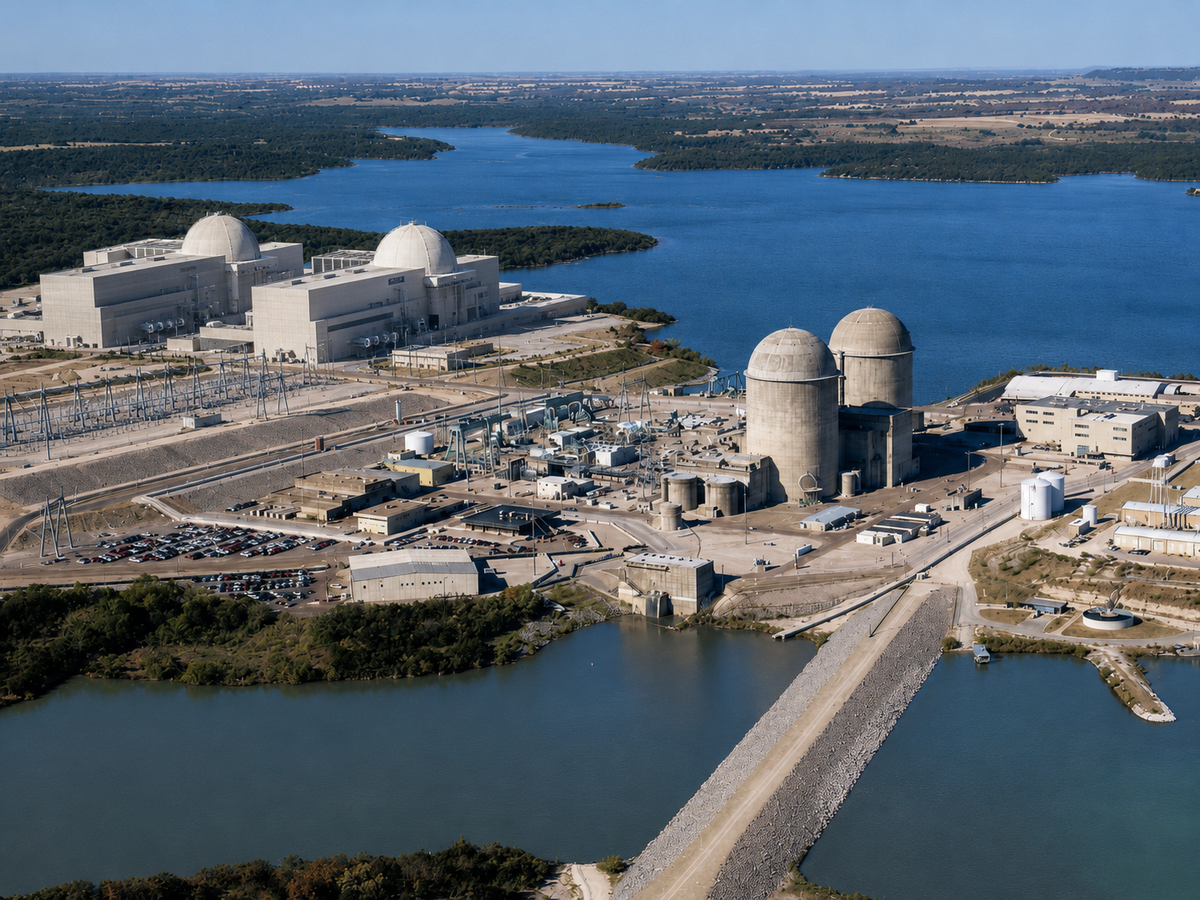
The best nuclear sites are not blank spaces on a map. They are usually brownfield sites with existing infrastructure, operating experience, community familiarity, transmission access, water planning, emergency preparedness, security culture, and institutional knowledge. Comanche Peak has all of it. It is already a nuclear plant. Its two existing units have operated for decades. Its owner, Vistra, is one of the most important power companies in Texas. And Amazon has already made the site a hyperscale anchor: a 20-year, 1,200 MW power purchase agreement with Vistra’s existing units, and a data center rising next door. That deal is for the operating plant, not Units 3 and 4 – but it is proof of exactly the demand a new build would serve, and Vistra has publicly stated it is exploring new advanced reactors at Comanche Peak. The offtake for the new units isn’t signed yet. But the on-ramp to it plainly is.
This matters because a revived expansion would not begin with the hardest question in nuclear development: where do we put it? Texas answered that question once already. In 2008, Luminant submitted a combined license application to the NRC for two US-APWR units at Comanche Peak. That was not a vague expression of interest. It was a real Part 52 licensing effort for a real two-unit expansion at a real Texas nuclear site. The review was later suspended, tied in part to delays in Mitsubishi Heavy Industries’ US-APWR design certification and the post-Fukushima market. But the key fact remains: Texas already began this project, and much of the work still sits on the docket.
Brownfield nuclear expansion is not easy, but it is vastly more legible than greenfield development. The politics are clearer, the workforce story is stronger, the transmission conversation starts from an existing node, and the public can see what nuclear operations look like because the plant is already there. A revived project would still need fresh cost estimates, updated licensing analysis, transmission planning, supply-chain and water review, and seismic and site-specific updates. But those are project-development problems, not conceptual objections. Texas does not have to imagine what a nuclear expansion site might look like. It can start with the one it already has.
The US-APWR is the Fastest Way to a Second Vendor
The case for the US-APWR is not that bigger is better in an abstract sense. Rather, the benefit is that the US-APWR is uniquely tied to the Comanche Peak expansion, and MHI is uniquely positioned to become that missing second vendor fast.
Three facts carry it. First, the prior work exists. The design certification is suspended, not withdrawn. Years of completed NRC safety review remain on the docket, and the Comanche Peak site Environmental Impact Statement was finished in 2011. A revived application starts years ahead of a blank page. Second, the capacity is decisive for the market that needs it most. At roughly 1,700 MWe, the US-APWR is one of the largest Gen III designs in the world: about 50% more power per unit than the AP1000's roughly 1,100 MWe, and many times the output of the small modular reactors getting most of the attention. Two US-APWRs produce the power of three AP1000s, with one fewer construction project, license, and set of site interfaces. In a state where ERCOT's summer peak is projected to climb from about 86 GW toward 145 GW by 2031, with near-term reserve margins already running negative, capacity per unit is the whole game. Third, the conditions that stalled the project the first time have reversed: Japan’s restart program is well underway — roughly half the fleet, 15 reactors, back online and climbing — which has freed up MHI’s domestic attention; and Texas prices and load have inverted into a structural surge.
The challenges are real, and none should be hand-waved away. The US-APWR is not a completed, NRC-certified design today. The original review was incomplete, not nearly finished – the open items when it was suspended, the digital instrumentation-and-controls platform and the seismic analysis, would require major engineering engagement. MHI would have to recommit to the US market. Vistra would have to decide that the expansion fits its strategy. But the regulatory ground has shifted in exactly the way that matters. The NRC's SECY-26-0034 now contemplates suspended applications building on previously submitted materials – a pathway framed with the AP1000 in mind that the Commission should extend to a second large-reactor design. Executive Order 14300 directs firm licensing clocks and tells the Commission to weigh economic and national-security benefits. Crediting prior work does not mean rubber-stamping an unfinished review. A realistic design-certification timeline runs roughly 24 to 36 months, inclusive of resolving those open items and pre-application diligence by Vistra and MHI. Set against the original six-plus-year review, that would be transformative.
The closest like-for-like precedent – the APR1400, a large evolutionary PWR certified in about 45 months under the pre-reform regime – sets a conservative ceiling, not a target. Conditional on MHI re-engaging with a complete, refreshed package, and with EO 14300’s deadlines and the modernized digital-I&C framework now in force, a 24-36 month review is realistic. Assuming the reforms hold and continue, the gating risk becomes sponsor re-commitment, not NRC speed.
Clear the Path, and the Money Flows
First-of-a-kind construction risk is real. A lender can price equipment, EPC capability, and creditworthy offtake. But it cannot price licensing delay, shifting regulatory requirements, and carrying costs with no enforceable end date. That is the risk that turned Vogtle into a balance-sheet warning label, and which has historically made nuclear projects anathema to merchant power markets.
It’s true that some of this is to be expected with the first-ever unit of any project, particularly complex ones. But most of that risk is a regulatory artifact. When licensing has no hard deadline, environmental review can expand without limit, and safety questions can reopen deep into construction, the cost of capital becomes a political variable. The answer is to remove the government-created risk, not subsidize around it. Government’s primary role should be to clear the path that it blocked.
Vogtle proves the point. Vogtle had the federal backstop: roughly $12 billion in DOE loan guarantees. The Associated Press stated the lesson plainly: Vogtle’s power “will never be cheaper than other sources Georgia Power could have chosen, even after the federal government reduced borrowing costs by guaranteeing repayment of $12 billion in loans.” The loan guarantee did not prevent the blowup or make the power cost-competitive. It shifted the downside onto taxpayers and ratepayers.
That is the wrong template for Comanche Peak 3 and 4, and for a country trying to rebuild nuclear competition. The central disease is concentration risk: one recent large-reactor builder, one precedent, one narrow supply chain. Writing an 80%-of-cost federal loan to stand up one specific vendor’s design makes the government pick the second winner. The pro-competition policy clears the path for every design and lets private capital allocate the risk.
That means the affirmative case for Comanche Peak cannot depend on a government check. If the NRC bounds the licensing schedule, environmental review is rationally narrowed to real site-specific issues, and hyperscaler offtake is real, private capital plus 20-year contracts can finance the plant.
None of this means a developer must refuse financing that already exists. So long as the government lavishes far larger, far less conditional subsidies on solar and wind, there is nothing hypocritical about using tools including DOE loan authority or Texas’s HB 14 nuclear fund. Refusing tools that your subsidized competitors use freely is not principle. It is unilateral disarmament. The principled position is to advocate for ending all of it. The distinction is use, not dependence. Use existing LPO/EDF financing mechanisms as self-defense. Build the project so its viability does not rest on them.
Texas has already shown why financing is rarely the binding constraint. The Texas Energy Fund, a separate program, offered cheap, 3%, 20-year loans to finance up to 10,000 MW of new gas generation. Two years in, the state has signed only about $3 billion in loans and actually disbursed $1.26 billion, with just two plants – about 900 MW – online, and the program is on track to fall well short of its 10 GW goal. Most telling: several developers have walked away from the loans entirely, some because firming demand let them line up private financing and drop the state money. When the economics and offtake are weak, cheap government money sits unused. When they are strong, private capital follows on its own.
The repeatable model for nuclear abundance is hard licensing deadlines, science-based safety standards, and a grid that pays for reliability rather than political objectives. Those reforms lower every reactor’s costs, not just this one project. Clear the path, let customers and private capital decide, and let block size and other characteristics – not a federal loan – justify the project.
Texas and the NRC Should Clear the Path and Let the Market Build
A major nuclear buildout would strengthen Texas across multiple dimensions: grid reliability, a credible growth path for hyperscalers, construction and operations jobs, and a beachhead for nuclear supply chains and skilled trades. It would also preserve the state's basic energy identity. Texas became an energy superpower by building oil, gas, pipelines, refineries, petrochemicals, wind, transmission, LNG, and power markets at extraordinary scale. The next test is whether it can build the firm industrial power system the AI-industrial era requires. A revived Comanche Peak expansion would say yes.
The government’s proper role here is to clear the obstacles it created and let the engineers and financiers do the rest. Most of what has made nuclear slow and expensive in America is regulatory: indeterminate licensing timelines, permitting friction, and transmission planning that treats a multi-gigawatt plant as an ordinary interconnection request. Fixing those is squarely the state's job. Directing the investment, picking the winner, or organizing the project from Austin is not. Let private capital and creditworthy offtake build the plant; let the state make the licensing, permitting, and transmission environment fast and predictable enough that they will.
That also disciplines the large-load debate the right way. Instead of treating data centers as passive consumers of scarce capacity, Texas should invite the largest new loads to anchor new supply. Hyperscalers that want gigawatts of power should sign long-term contracts supporting gigawatts of generation. No subsidies for queue squatting. No blank checks from ratepayers. No pretending intermittent generation is the same thing as 24/7 firm capacity. Bring real load, bring real credit, sign real offtake, and help build real power. Comanche Peak 3 and 4 are exactly the kind of project around which that bargain could be organized.
The Action Agenda
Texas should move quickly, but it should move deliberately.
First, Vistra, MHI, the State of Texas, ERCOT, and major potential offtakers should fund a bounded feasibility sprint on the revived US-APWR pathway – not a press release, not a symbolic task force, but a real commercial, regulatory, and technical review covering technology and licensing, the Comanche Peak site, and the delivery and financing model. The goal is to determine what prior licensing work remains useful, what must be updated, and what timeline is achievable under current NRC rules. That study is itself the first fundable deliverable, and precisely the pre-development work Texas's HB 14 fund and DOE's financing program were built to reimburse – exactly the kind of existing tool a serious developer would be foolish to leave on the table while other technologies receive far more generous support.
Second, Texas should identify the transmission upgrades a multi-gigawatt expansion at Comanche Peak would require, and plan them as grid infrastructure rather than a lone interconnection request.
Third, hyperscalers and large industrial customers should put real money behind their stated demand for nuclear electricity, through long-term PPAs – the offtake that makes a new reactor privately financeable in the first place, not a socialized cost on ordinary ratepayers.
Fourth, the workforce pipeline should be part of the project from day one. Reactor vendors, EPC firms, community colleges, and trade programs should organize around nuclear construction and operations now. MHI brings deep nuclear training infrastructure from Japan (operator and simulator-based instruction, maintenance training, and systems for mapping nuclear engineering skills) and a revived Comanche Peak program should bring that model to Texas rather than scrambling for workers after the project begins.
Fifth, policymakers should make the regulatory environment fast and predictable for any large nuclear project that adds firm capacity. That does not mean a blank check or a favored design. It means aligning permitting, transmission planning, and regulatory support so that projects which actually deliver dependable power are not strangled by process. The purpose is not to privilege one company or one reactor. It is to prove that Texas can still build the kind of infrastructure the future requires – and to make sure the country has more than one vendor able to build it.
Build the Reactors Texas Already Planned
Texas does not need to wait for a perfect future reactor before it goes all-in on nuclear power. It does not need to choose between advanced nuclear and large nuclear. It does not need to pretend that every solution must be small, novel, or decades away. The state already has a nuclear expansion candidate hiding in plain sight, and reviving it happens to be the fastest way to give America the second large-reactor vendor it badly needs.
Comanche Peak 3 and 4 should be the flagship test case for Texas's nuclear future. Start with the US-APWR pathway, because that is the pathway Texas already began. Study it honestly. Price it honestly. Compare it honestly. But do not ignore it. The future of the Texas grid will not be secured by slogans about innovation. It will be secured by steel, concrete, turbines, transformers, trained workers, major licensing work, and long-term customers willing to pay for dependable power. Texas should not wait for a nuclear moonshot. It should clear the path for the two large reactors Comanche Peak had already planned, then let private capital build them—and allow its sponsors and other customers to turn that two-unit block into a repeatable model for nuclear abundance.