The Paperwork Reactor: Why Nuclear Licensing's Documentation Burden Is a Structural Finance Problem
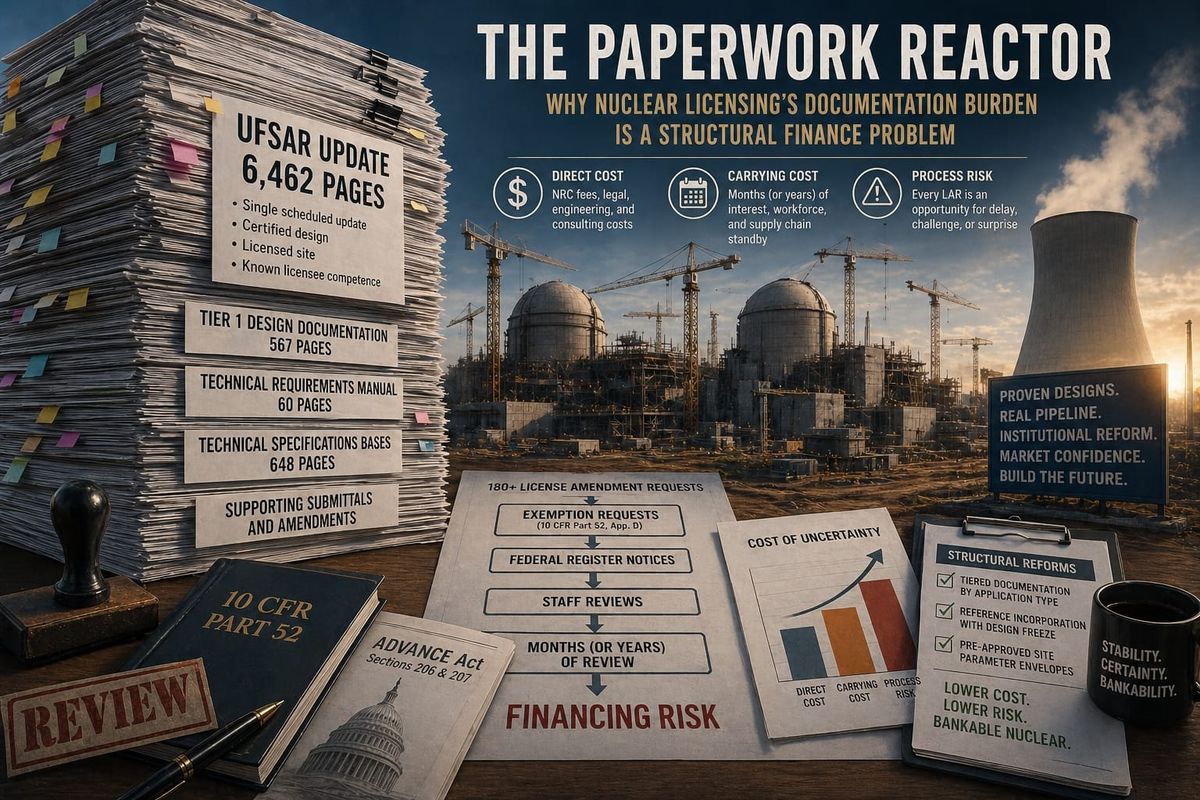
In 2022, Southern Nuclear Operating Company filed its Revision 11 update to the Updated Final Safety Analysis Report for Vogtle Units 3 and 4. The filing ran to 6,462 pages. That was just the UFSAR. Accompanying it were another 567 pages of Tier 1 design documentation, 60 pages of Technical Requirements Manual, and 648 pages of Technical Specifications Bases.
A single scheduled update. For a plant whose design had already been certified. At a site that had already received its Combined Construction and Operating License (COL). Operated by a licensee whose competence was already known to the regulator (6 prior reactors, the earliest of which came online in 1975).
The first two articles in this series have made the case that nuclear licensing's structural problems lie in the instability of certified designs and the absence of binding regulatory timelines. This third piece addresses the problem that sits alongside both: the sheer accretion of documentation that the system requires, independent of any substantive safety work. The pattern matters because even if Congress were to enact type certification reform and statutory shot clocks tomorrow, the documentation architecture alone would still impose financing costs that no other regulated sector tolerates.
The Scope of the Problem
Nuclear licensing documentation is not merely voluminous. It is voluminous in a specific and financially consequential way: it scales linearly with each new application, each new site, each new amendment, and each update cycle, with limited efficiency gains across projects that use the same certified design at similar sites.
Consider the AP1000 pipeline. The Westinghouse AP1000 Design Control Document (the foundational technical document that supports every AP1000 COL application) is itself a multi-thousand-page reference work, with individual chapters routinely running 400 to 500 pages each. Each COL application that references the DCD must then layer on site-specific documentation: geology, hydrology, meteorology, seismicity, population density, emergency planning, water intake, grid interconnection. The Vogtle COL application went through multiple revisions and supplemental submittals before issuance. The Turkey Point COL application went through eight major revisions between 2009 and 2018, with a "roadmap" document required just to help NRC staff understand what had changed between versions.
And documentation does not stop at COL issuance. Each license amendment request (LAR)—of which Southern Nuclear filed over 180 during Vogtle construction⁶—requires its own dedicated safety analysis, regulatory citation, staff review, and often a Federal Register notice and may require an environmental review. Many also require a separate exemption request under 10 CFR Part 52 Appendix D, with its own supporting documentation package. The aggregate documentation burden across a single two-unit AP1000 project runs to tens of thousands of pages of safety-related filings before the first electron is delivered to the grid.
None of this documentation is gratuitous as a matter of regulatory design. Every element was added in response to some historical event or policy judgment. The aggregate, however, is a structure that would have been recognizable to a 1970s-era regulator licensing the first generation of light-water reactors – a structure that assumes each reactor is effectively first-of-a-kind and that every piece of safety information must be developed from scratch.
That assumption no longer matches reality. And the financing implications of that mismatch are significant.
Why Documentation Volume Is a Financing Problem
For capital markets professionals, the question is not whether the documentation is useful. It is whether the documentation burden is calibrated to the marginal safety information it produces. In many cases, it is not.
Three specific financing costs follow from the current documentation architecture.
The first is direct cost. NRC hourly review fees are currently $317 per professional staff hour, with advanced reactor applicants and pre-applicants benefiting from a reduced rate of $148 per hour under Section 201 of the ADVANCE Act. Either rate, multiplied across thousands of staff hours per COL application and hundreds of hours per material license amendment, produces substantial direct expense. A COL review can cost an applicant tens of millions of dollars in NRC fees alone, separate from the applicant's own legal, engineering, and consulting costs to prepare the documentation. For the cancelled reactors 3 and 4 at STP in Texas, Toshiba spent a combined $788 million and over 11 years on a project that never even broke ground.
The second is carrying cost. Each month of review time is a month of interest accrual on pre-construction capital, workforce standby, and supply chain reservation. The type certification and shot-clock pieces of this series addressed this directly; the point here is that documentation volume is itself a driver of review time, independent of any regulatory willfulness. Staff cannot review faster than the documentation allows them to.
The third, and most important for structured finance, is process risk. Every LAR is a potential off-ramp — an opportunity for a contested hearing, a Federal Register comment period, a change in regulatory position, or an extended review that disrupts construction sequencing. A project with 180 LARs is a project with 180 opportunities for regulatory surprise. The documentation architecture, by generating that many discrete regulatory events, fundamentally increases the variance of project outcomes. Variance is the enemy of underwritable risk.
Three Structural Reforms
A documentation reform package for nuclear licensing would need three elements, each addressing a different layer of the problem.
First, tiered documentation requirements by application type. The current regime effectively applies a single documentation standard across applications that differ enormously in regulatory risk profile. A certified-design COL at a brownfield site with existing nuclear infrastructure should not require the same documentation as a novel-design application at a greenfield site. The FAA's approach to aircraft certification provides a direct template: the first article in this series addressed how type certification creates tiered review for certified designs, and the same logic extends to documentation. Three tracks would be appropriate: full documentation submission for novel designs or greenfield sites; abbreviated submission for certified designs at previously unlicensed sites; and notification-only or heavily streamlined documentation for certified designs at existing licensed sites. The substantive safety work in the third category is largely complete before the application is filed. The documentation should reflect that.
Second, genuine reference-document incorporation. The theoretical structure of Part 52 allows an applicant to incorporate a certified design by reference, but in practice the Design Control Document (DCD) keeps getting amended, and each amendment triggers fresh documentation obligations downstream. A reformed framework would freeze the reference design for construction purposes once a COL is issued, with a narrow and statutorily defined process for post-issuance design changes. An applicant who says "we are building Revision 19 of the AP1000 DCD, unchanged" should be able to make that statement with full legal effect, without re-filing the underlying documentation and without exposure to mid-construction reopening of the referenced design.
Third, pre-approved site parameter envelopes. A significant portion of site-specific documentation exists because the NRC's current approach treats each site as analytically unique, even when dozens of candidate sites share substantially similar characteristics. A reformed framework would define pre-approved parameter envelopes for key site characteristics — seismic zones, flood elevations, cooling water sources, population density ranges — and allow any site falling within those envelopes to be qualified without further site-specific analysis. Section 206 of the ADVANCE Act directs the NRC to consider exactly this kind of standardization for brownfield and retired fossil fuel sites, instructing the agency to evaluate "utilizing standardized site parameters" and "standardized applications for similar sites." The NRC has initiated implementation work, but formal adoption of parameter envelopes as a binding regulatory pathway — not merely guidance — would substantially reduce documentation burden for the class of applications most likely to drive near-term deployment.
What the ADVANCE Act Gets Right, and What Is Still Missing
Recent legislation has begun to address parts of this problem. Section 206 of the ADVANCE Act specifically directs the NRC to evaluate whether its regulations, guidance, and policies should be modified to support efficient, timely, and predictable licensing of nuclear facilities at brownfield and retired fossil fuel sites, with particular attention to reuse of existing infrastructure, use of early site permits, standardized site parameters, and standardized applications for similar sites. Section 207 requires the NRC to establish an expedited procedure for qualifying combined license applications.
These are meaningful directives. The NRC has responded with active implementation work — public meetings, draft guidance revisions, and a rulemaking to revise 10 CFR Part 51 to streamline NEPA reviews for brownfield sites. The direction of travel is correct.
What is still missing is the same structural feature that was missing from the licensing timeline reforms addressed in the second piece of this series: durability. The ADVANCE Act directs the NRC to "consider" and "evaluate" and "develop strategies." It does not, on its face, mandate specific documentation relief tied to defined triggers. The brownfield report to Congress was due in September 2025, and implementation guidance is proceeding through normal NRC channels—which is to say, through a process that the next administration's NRC leadership can accelerate, slow, or redirect.
For capital markets participants pricing long-duration nuclear project finance, administrative guidance on documentation relief is not materially more durable than administrative guidance on licensing timelines. The underlying problem is the same: that reforms are being implemented through regulatory discretion rather than statutory command. And the capital markets response should be expected to be the same.
A Brief Note on AI and the Limits of Tooling
It is common to hear that AI will solve the documentation burden. The argument is not wrong, but its efficacy is limited.
AI-assisted document preparation is genuinely useful for large-scale regulatory filings. Drafting, cross-reference verification, consistency checking across thousands of pages, citation formatting, and identification of language that needs updating in response to regulatory changes are all tasks where current AI tools produce meaningful efficiency gains. Applicants, law firms, and even the NRC itself will increasingly use these tools, and the cost of producing any given volume of documentation will fall.
But AI reduces the marginal cost of generating documentation; it does not reduce the regulatory requirement to produce it. If the NRC requires a 6,462-page UFSAR update, AI can help the applicant produce that document more efficiently. It cannot reduce the 6,462 pages to 1,000. Only rulemaking and statutory reform can do that.
The combination (documentation reform that reduces required volume, plus AI tooling that reduces the cost of producing what remains) is where the genuine efficiency gains are available. AI alone is a cost reducer within the existing framework. Reform is a framework change. The two are complements, not substitutes, and it is a mistake to treat tooling as a substitute for structural fix.
The Capital Markets Case
The three pieces in this series have addressed different dimensions of the same underlying problem. Design instability creates regulatory re-openability mid-construction. Timeline indeterminacy creates open-ended review periods without binding conclusion. Documentation volume creates direct cost, carrying cost, and process risk that compound the first two.
Each problem is independently solvable. Type certification reform addresses design stability. Statutory shot clocks with binding default consequences address timeline certainty. Tiered documentation with genuine reference incorporation and pre-approved parameter envelopes addresses the paperwork reactor problem. Each reform reduces a distinct component of the risk-adjusted cost of nuclear project finance.
None of them, individually, is sufficient. All three, together, would fundamentally change what it means to underwrite a nuclear project in the United States. The pipeline is real – AP1000 planning in Texas, Poland, Bulgaria, India, and Ukraine, combined with brownfield and same-site expansion opportunities at Vogtle, Comanche Peak, Turkey Point, and elsewhere – and the designs are proven. What remains is the regulatory architecture that would allow capital to flow at the scale and cost the buildout actually requires.
The questions are not technical. They are institutional. And institutional questions are answered by legislation, not by executive order or agency guidance.
Administrative reforms can be undone. Statutory reforms cannot. Markets cannot underwrite eighty-year assets against legal frameworks designed to last four.
The author is a structured finance attorney focusing on energy and capital markets transactions. The views expressed are the author's own.